Inside the demanding realm of modern serious oversteer competition, success is not merely solely a result of raw engine power or driver courage. Rather, it has become a multifaceted engineering challenge which requires a painstaking marriage of picking a proven chassis, outfitting it with the correct competition components, and, most critically, understanding its live behavior on the circuit through advanced drift telemetry software. This exhaustive guide functions as your blueprint from the very first concept of a drift build all the way to the last engineering-refined tweaks that elevate a strong machine into a repeatable champion. We will thoroughly explore the art and science of chassis dynamics adjustment, showing how a state-of-the-art drift tuning app like a dedicated telemetry system eradicates assumptions and delivers unmatched clarity into your vehicle's actual dynamics.
The cornerstone of any successful competitive sliding vehicle is, without question, the platform itself. Several platforms have attained renowned status within the international drifting culture due to their natural balance, strong build quality, and the enormous availability of performance support available. Selecting the correct platform is the first and most important decision a driver will make. To illustrate, the BMW E36 is commonly accepted as perhaps the the best all-around drift cars of the modern era. Its excellent evenly distributed mass, alongside a rear-wheel-drive setup and extremely reliable inline-six engines, establishes a car that is at once easy to handle for novices and incredibly competitive in the possession of a professional driver. The next step of this lineage, the BMW E46, refines these strengths with a increasingly developed structure, wider track for improved high-speed stability, and still more turning capability directly from the manufacturer. A distinct dominant platform in the professional arena is the Chevrolet Corvette C6.
This V8-powered performance car offers a distinctive array of benefits to the sliding discipline, featuring a lightweight aluminium frame, a backwards-positioned transaxle that contributes to an perfect balance, and the tremendous low-end power of a large-displacement LS V8 motor. This combination renders it an absolute force on track, designed of starting and holding extended slides with relatively minimal deployment of power. For builders desiring remarkable performance per dollar, the 350Z model Nissan rises above as a top-tier choice. It arrives from the manufacturer with a stiff body structure, a competent original LSD, and the smooth V6 engine that offers plenty of performance for mastering and moving up in the activity. Its successor, the Nissan Z34, presents more improvements in body strength, handling precision, and outright motor performance, cementing its place as a favorite selection among serious drivers. Further legendary platforms that warrant attention encompass the nimble Wankel-engined Mazda FC, the most popular Nissan S13, the American SN95 generation Mustang, the electronic-equipped BMW E90, and the tiny yet surprisingly playful and instructive Mazda MX-5. All of these chassis gives a unique array of attributes, complexities, and capabilities, but they all have in common the core elements necessary to become a serious drift machine.
However, selecting the optimal car is just the first step. To release the complete capability of any of these machines, significant upgrades to the steering geometry and chassis control systems are completely non-negotiable. This is where the world of precision aftermarket hardware becomes sharp focus. The single most impactful upgrade for a dedicated competition vehicle is the installation of a high-performance drift angle kit. These advanced assemblies, such as those engineered by performance brands like specialist manufacturers, are engineered to radically expand the vehicle's possible turning lock. A factory production vehicle is highly restricted in how far its front wheels can pivot, a engineering compromise for daily operation. In drifting, conversely, extreme opposite lock is frequently required to manage and hold a drift. An modification kit exchanges the stock uprights, rod ends, and sometimes control arms with pieces that enable the front tires to achieve steering lock over 70 or even 80 degs, versus a average stock limit of around 40 to 50 degs.
This immensely greater steering angle offers the driver with exponentially greater control during a drift, allowing it to be considerably simpler to initiate a drift, hold it through a sweeping bend, and change smoothly from one angle to the opposite. The improvement in controllability is absolutely transformative. Coupled with a correctly specified modification is the every bit as essential enhancement to the car's spring and damper setup. Generic or even expensive road coilovers are generally not engineered for the unique and extreme requirements of drifting. A purpose-built pair of coilovers is of utmost importance. These specific coilovers have specific valving and spring rates that are designed for the violent weight transfer that is typical of aggressive driving. When a pilot begins a drift, the chassis's mass is shifted rapidly to the front of the corner. Correct drift-spec suspension manage this movement in a predictable way, permitting the car to find its balance rapidly and giving the operator accurate feel through the controls and cockpit. They furthermore provide precise tuning of ride height, damping firmness, and weight balance, which are all integral aspects of optimizing the vehicle's handling to a particular circuit or piloting approach. As a system, a high-quality steering angle kit and a expertly chosen set of competition suspension units are the absolute mechanical base upon which all future refinement is built.
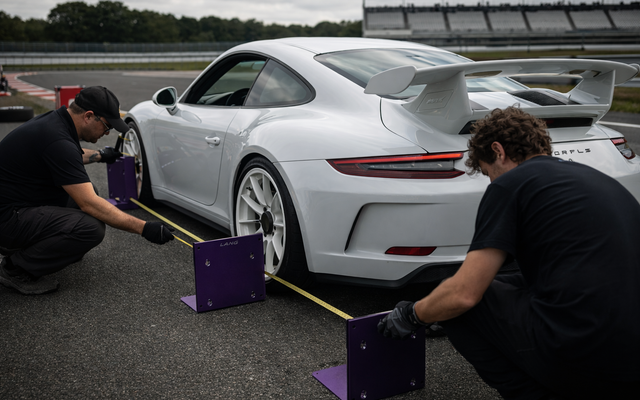
Once the core hardware is installed, the next critical phase in the project is the precise tuning of the vehicle's suspension geometry. This is the world of chassis dynamics adjustment, a process that can feel daunting to the uninitiated but is, in reality, the defining factor to converting a collection of capable parts into a cohesive and predictable whole. The most discussed aspect of tuning for oversteer is undoubtedly camber. Camber is the angle of the rim in relation to the perfectly straight line when looked at from the front-on of the car. When the upper part of the tire is leaning towards the chassis, this is referred to as inward tilt. For sliding, inward-leaning wheels on the front axle tires is widely applied and is seen as necessary. The reason is deeply tied to physics.
When a vehicle is going around a bend at high slip angles, the chassis tilts toward the outside of the corner. This lean makes the outer steering tire to reduce its optimal grip area with the tarmac. By introducing inward lean, the wheel is pre-angled to compensate for this tilt. As the vehicle leans into the turn, the tire becomes more upright against the asphalt, optimizing its traction at the exact time when it is most required for control. Commonly, front angles for a dedicated sliding vehicle range from approximately -3 degrees to as extreme as -5 degrees or even more, depending on the details of the vehicle setup, tire selection, and operator feel. The rear wheels also use negative camber, but the settings are generally more modest and more nuanced than the front axle. Too much camber at the back can result in the chassis overly loose and challenging to predict on acceleration use, as it reduces the effective grip area of the driven wheels during forward power delivery. Therefore, rear adjustments are commonly in the ballpark of -1 degree to -3 degrees, finding a precise equilibrium between providing adequate side traction to aid in starting and holding the slide while still keeping good grip for acceleration the bend. Camber is only one element of the broader alignment car alignment tuning puzzle, which furthermore encompasses toe setting, caster, and suspension-induced steering correction.
Toe setting refers to the orientation of the tires when viewed from the top. Toe-in means the front edges of the wheels are closer together than the rear edges, while negative toe means the converse. For drifting, a small amount of front axle toe out is commonly employed to improve the turn-in handling response, making the car feel more agile and ready to start a slide. Rear axle toe angle is usually set to zero or a very minute amount of inward toe to encourage predictability under acceleration. Caster is the longitudinal or backwards tilt of the steering axis when observed from the side-on of the vehicle. More positive caster increases self-centering and high-speed confidence, and it furthermore boosts camber increase during steering, which is highly useful. Adjusting these settings is a detailed interaction where a change to a single setting can and often will impact the remaining parameters. The traditional approach for tuning a vehicle's suspension geometry for competition has long been a tedious process of guesswork and adjustment. A tuner or engineering group would introduce a modification based on a hunch, run the chassis on track, depend on the operator's individual perception and feedback, and then introduce another tweak. This cycle would repeat time after time until the car felt "acceptable" or the available testing period vehicle dynamics tool was exhausted. This system is not only extremely wasteful in terms of time and tires, fuel, and parts, but it is furthermore fundamentally inaccurate.
Pilot feel is a infamously inconsistent measurement tool, colored by numerous factors such as exhaustion, varying track surfaces, temperature, and merely the focus of the pilot on that particular run. What feels "oversteery" on one lap might feel "pushing" on the subsequent run, causing conflicting feedback and counterproductive changes. This traditional problem in vehicle dynamics optimization is specifically where contemporary engineering tools has intervened to completely change the landscape.
The development and integration of advanced suspension tuning suspension tuning tool applications has brought about a radically different paradigm for engineering and refining high-performance drift machines. This new generation of tools, showcased by innovative solutions like modern telemetry hardware, operate by physically capturing the live dynamic performance of the chassis as it is piloted on the course. Unlike relying on subjective feel, these devices collect quantifiable data on essential parameters such as shock absorber movement, individual tire rotation, lateral and longitudinal g-forces, wheel angle, and driver input position. This collected information flow is then analyzed by powerful software that can visualize and interpret the information in a actionable way. For the very first time, drivers and crews can see specifically what the vehicle is doing at each moment of a lap. This ability transforms the complete suspension tuning workflow. Consider the particular goal of dialing in the front axle camber for a given chassis. As an alternative to making a adjustment from -3 degrees to -3.5 degrees and then testing many laps to try and "feel" a difference, a telemetry system can give immediate and irrefutable information. The tool can display visually how the wheel's loading is acting during the key stages of a drift: initiation, holding the angle, and changing direction. It can reveal if the present angle is permitting the outside front tire to maintain optimal contact or if the rubber is overloaded on its external shoulder.
The software can subsequently provide data-driven recommendations for modification. Perhaps the telemetry shows that the tire is even stressing its outer shoulder at -3.5 degrees of negative camber, indicating that an increase to negative camber, say -4 degrees, might be warranted. Conversely, the information might reveal that the tread is not reaching temperature or that the inside edge is wearing too quickly, which could suggest that there is overly aggressive inward lean and a slight lessening back to -3.2 degrees would be better optimal. This standard of accuracy and actionable analysis was simply impossible in the days of pure manual tuning.
The effect of utilizing a advanced suspension tuning tool reaches far beyond only optimizing camber angles. It becomes an essential suspension tuning guide that is tailored to your specific car. When setting the damping clickers on your adjustable dampers, rather than depending on general advice or replicating another driver's setup, you can employ the software to see how the chassis is performing in relation to your changes. The tool can show the suspension travel path over a run, showing if the shocks are controlling the weight transfer properly or if they are allowing the vehicle to become unsettled too much after a transition. It can assist in diagnosing problems like hitting the bump stops or topping out, allowing you to make educated choices to spring preload, damping values, or ride height. This approach translates equally to the intricate task of suspension geometry optimization. Beyond camber angle, the software can offer analysis into how changes to toe and caster are impacting the chassis's stability during different maneuvers of a slide. For instance, it can allow you to find the best amount of front axle toe-out for your specific steering rack geometry and competition technique by measuring the speed of turn-in reaction and the consistency of the chassis at lock countersteer. This turns the system an exceptionally effective performance optimization handbook that is actively updated by the live behavior of your own chassis on the tarmac. It elevates the whole endeavor from a dark art into a scientific optimization exercise.
Additionally, the value of a system like GripDial is in no way restricted to experienced teams with extensive resources. For the grassroots competitor, it serves as an powerful equalizer. It practically offers the driver with the analysis of a full-time dynamics engineer without the typical expense. It accelerates the tuning process by providing unambiguous answers to challenges that would normally take years of trial and error to solve. A tuner can see how their specific vehicle behaves to various settings, building a more profound understanding of car control in the journey. It also makes accessible high-level performance tuning concepts, permitting every enthusiast with the drive to perfect their vehicle to achieve it in a efficient and effective fashion. This is notably valuable in a discipline like drifting, where engineering knowledge has in the past been a tightly held advantage among top teams. In the modern era, that power can be in the hands of every dedicated driver.
In the final analysis, the path to engineering and optimizing the perfect championship-contending drift car is a multi-stage project that seamlessly combines classic mechanical principles with cutting-edge telemetry solutions. It starts with the wise choice of a proven chassis, followed by the application of non-negotiable drift-spec hardware like high-performance steering angle kits and properly valved performance suspension units. The build then moves into the detailed stage of car suspension tuning, where parameters like camber, toe, and caster are meticulously adjusted to match the car's modified capabilities and the driver's personal technique. The final step, and what genuinely differentiates the modern approach from the past, is the use of a sophisticated vehicle dynamics tool. This platform eradicates the uncertainty and inefficiency of purely subjective tuning by providing objective, live telemetry on how the vehicle is actually performing. It serves as an unparalleled diagnostic aid, a comprehensive coilover setup manual, and a comprehensive chassis development system. In unison, this holistic philosophy guarantees that every component of the drift car—from the choice of the chassis to the last adjustment on the coilover—is refined for peak competitiveness on the competition venue. It represents the full progression of the sport of sliding, merging physical pilot talent with data-informed vehicle setup to create the perfect effective cars possible.